Hannover Messe 2026: When 'AI' Finally Stopped Being a Sticker
For three years, AI at Hannover Messe felt like a costume. Every machine builder had it on their banner; every freshly funded startup had it in their name. 2026 reads differently. Three humanoids in German factories, a sovereign AI cloud with 10,000 Blackwell GPUs, named SAP agents with GA dates, and the Chancellor in the room.
Hannover Messe 2026: When "AI" Finally Stopped Being a Sticker
For three years, "AI" at Hannover Messe was a costume. Every machine builder had stuck "AI-powered" on their banner because their PLC could compute a moving average. Every freshly funded startup had ".ai" in its name with a deck full of GPT wrappers and no machine to plug them into. The marketing was loud, the substance was thin, and the only honest sentence on most stands was the price tag.
2026 reads differently.
The Setup This Year
The headline numbers: roughly 2,900 exhibitors from over 50 countries,1 theme "Think Tech Forward", 20 to 24 April 2026. Three pillars dominate the floor: Industrial AI and Humanoid Robotics, Energy and Hydrogen, and a brand-new Defense Production Area. Industrial AI is not a side track or a pavilion. It is the announced exhibition topic.2
Brazil is partner country. ApexBrasil brought six pavilions, 140-plus companies, and over 800 Brazilian executives, the largest Brazilian industrial showcase abroad in decades.3 China sent roughly 700 exhibitors, second only to the German contingent itself.4 Xpeng has a stand in Hall 26.
The opening was done by German Chancellor Friedrich Merz and Brazilian President Luiz Inácio Lula da Silva, who used his address to challenge German automakers on biofuels and walked away with ten signed German-Brazilian industrial agreements.5 On day one, top industrial executives sat down with Merz to discuss scaling AI into broad industrial applications: Roland Busch (Siemens), Christian Klein (SAP), Tim Höttges (Deutsche Telekom). That is the German tech industrial complex in one room with the head of government. It is not the kind of meeting you book if the topic is still in its hype cycle.
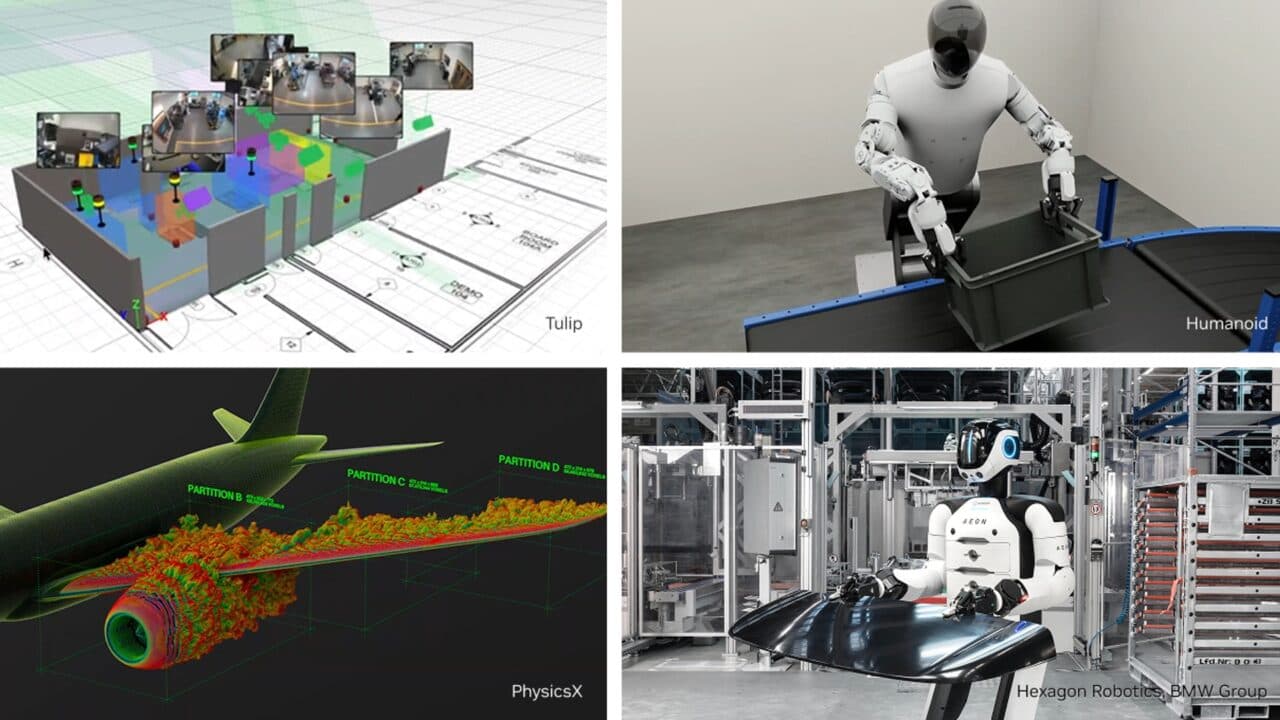
NVIDIA's pitch for the show: design, simulation, computer vision, AI agents, and robots running on one technology stack from the edge to the data center. (Source: NVIDIA Blog)
The Big Plays
Microsoft + Schneider Electric: governed agentic manufacturing
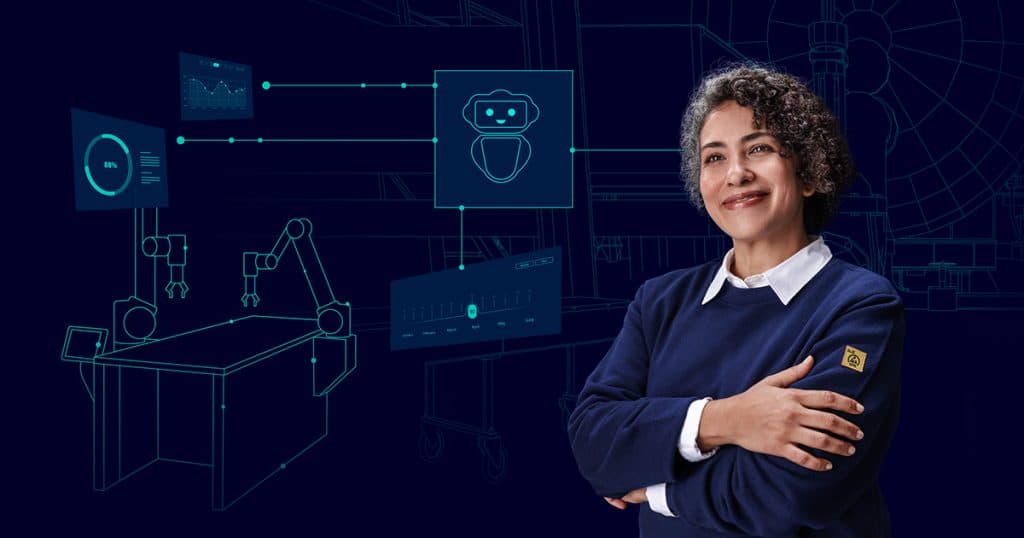
Microsoft and Schneider Electric announced a "governed agentic manufacturing platform" that lets autonomous AI agents coordinate production processes while keeping a human oversight layer in the loop.6 The word that matters in that sentence is governed. Last year's agent demos felt like uncontrolled YOLO loops shipped into a CIO's lap. The "governed" framing is what gets a procurement conversation past the first week.
Microsoft's overarching theme this year is "Industrial Intelligence Unlocked", and the opening keynote, "Return on Intelligence: The Next Frontier of Manufacturing", is presented by Deb Cupp (Microsoft President and CRO) on day one. The framing has shifted from "look at this cool agent" to "here is how it shows up on a P&L line". A small linguistic shift with a large procurement implication.
The procurement signal
"Governed agentic" is the phrase to listen for at every booth this year. If a
vendor uses it without being able to point to a permissions model, an audit
log, and a rollback story, the platform is a slide. If the words have APIs
behind them, the platform is real.
NVIDIA + Siemens + Omniverse: digital twins that actually render
The Siemens Digital Twin Composer, built on NVIDIA Omniverse, is on display in Siemens' Hall 27 booth, demonstrated jointly with PepsiCo. Their published claim: production planning for the PepsiCo line has been compressed from months to days.7 That last part matters more than the technology stack. There is a named customer with a number attached. For three years the digital twin pitch was "leading German automaker (logo blurred)". Naming PepsiCo on the slide changes who picks up the phone after the show.
Siemens' Hall 27 is the new Industrial AI hall this year. Booth A48 is where the Digital Twin Composer + PepsiCo demo lives. (Source: Siemens NX Manufacturing Blog)
NVIDIA's wider play covers accelerated computing, AI agents, vision AI, and humanoid robots running on Jetson Thor at the edge.8 The thesis they are selling is that all of it sits on the same stack from the GPU in the robot to the cluster training the model. The Hexagon, Wandelbots, Humanoid, and ABB demos this week are the proof points for that single-stack thesis.
Humanoid robots: three deployments in German factories, in one show
Humanoid robotics is the segment that has gone from sci-fi sidebar to real show floor in twelve months. Around fifteen companies are presenting working systems.9 The detail that matters: three of them have shipped deployments inside German production lines this year, not just demo loops on a stand.
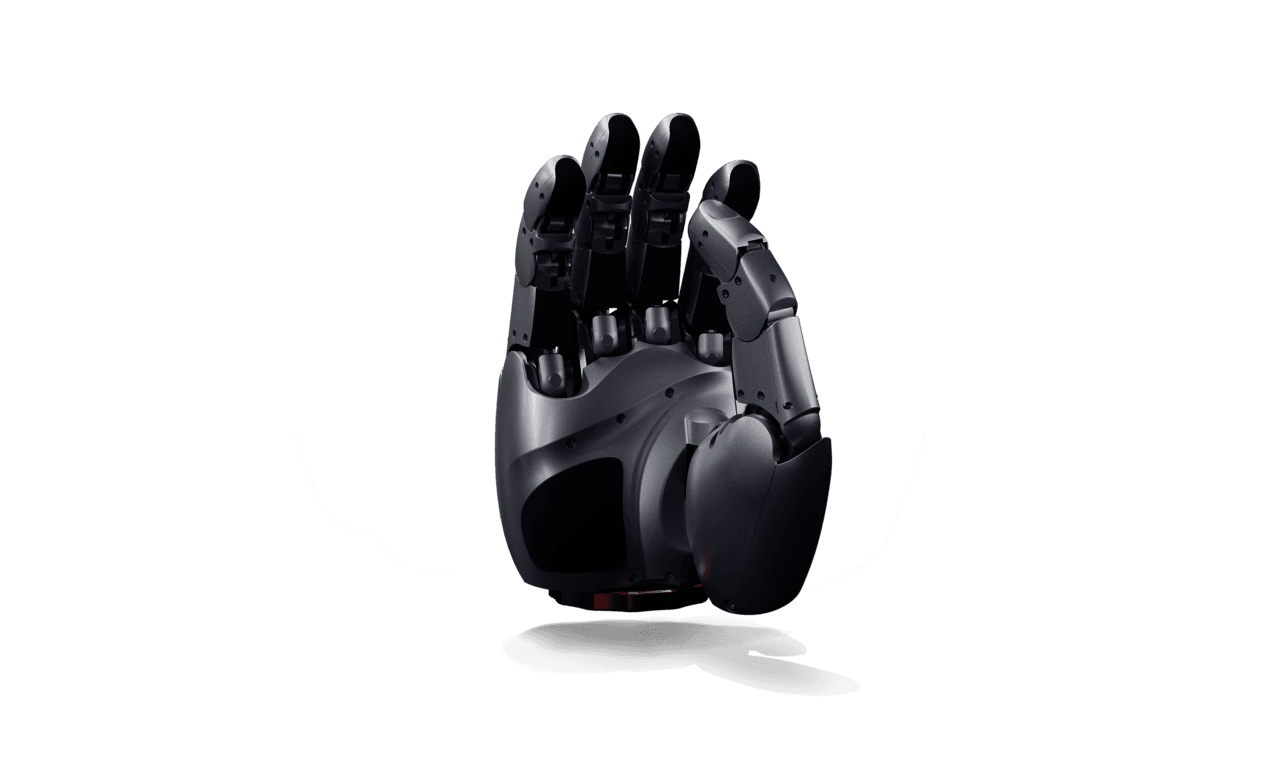
Agile ONE from Agile Robots is being pitched as Physical AI in industry: dexterous hands, real-time perception, autonomous decisions in complex industrial scenarios. Hall 27, Booth J72.
The bottleneck for humanoids in industry has not been brains, it has been hands. Agile Robots' dexterous hand is the kind of detail that decides whether a humanoid does demo loops or actually picks the part. (Source: Agile Robots)
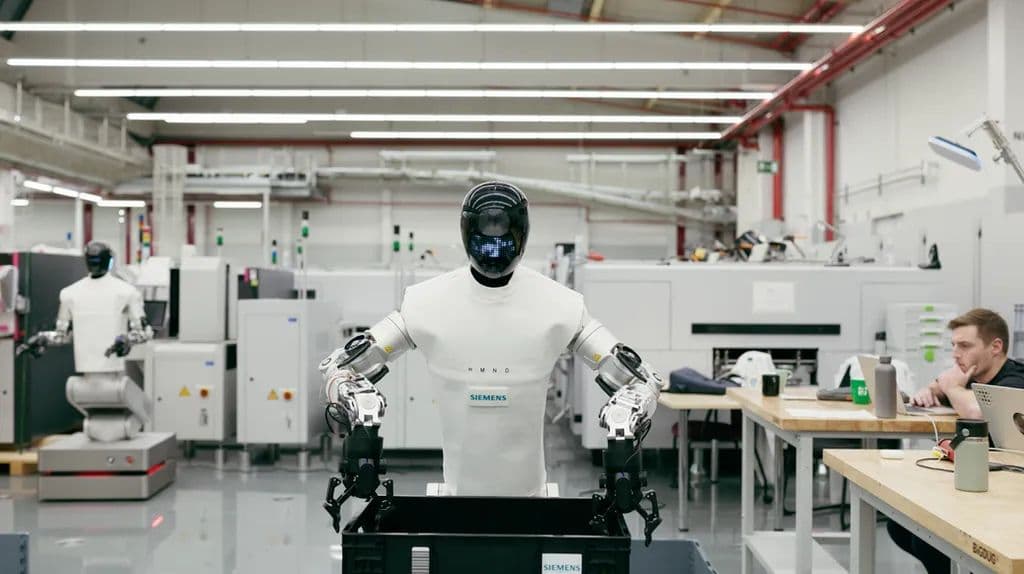
Humanoid's HMND 01, a wheeled humanoid running NVIDIA Jetson Thor as on-robot compute, developed using Isaac Sim and Isaac Lab, has completed autonomous logistics inside a Siemens blueprint factory in Erlangen. The numbers from the trial are concrete: more than eight hours of autonomous operation, sixty container moves per hour, a pick-and-place success rate above ninety percent.10
Humanoid's HMND 01 at the Siemens electronics plant in Erlangen. Eight-hour autonomous shifts, ~60 totes/hour, >90% success on pick-and-place. (Source: IoT Now)
The detail that matters most for HMND 01: simulation-first development cut the hardware development timeline from a typical eighteen to twenty-four months down to seven.8 That is a structural change in how robotics companies will be built going forward, not just a single product win.
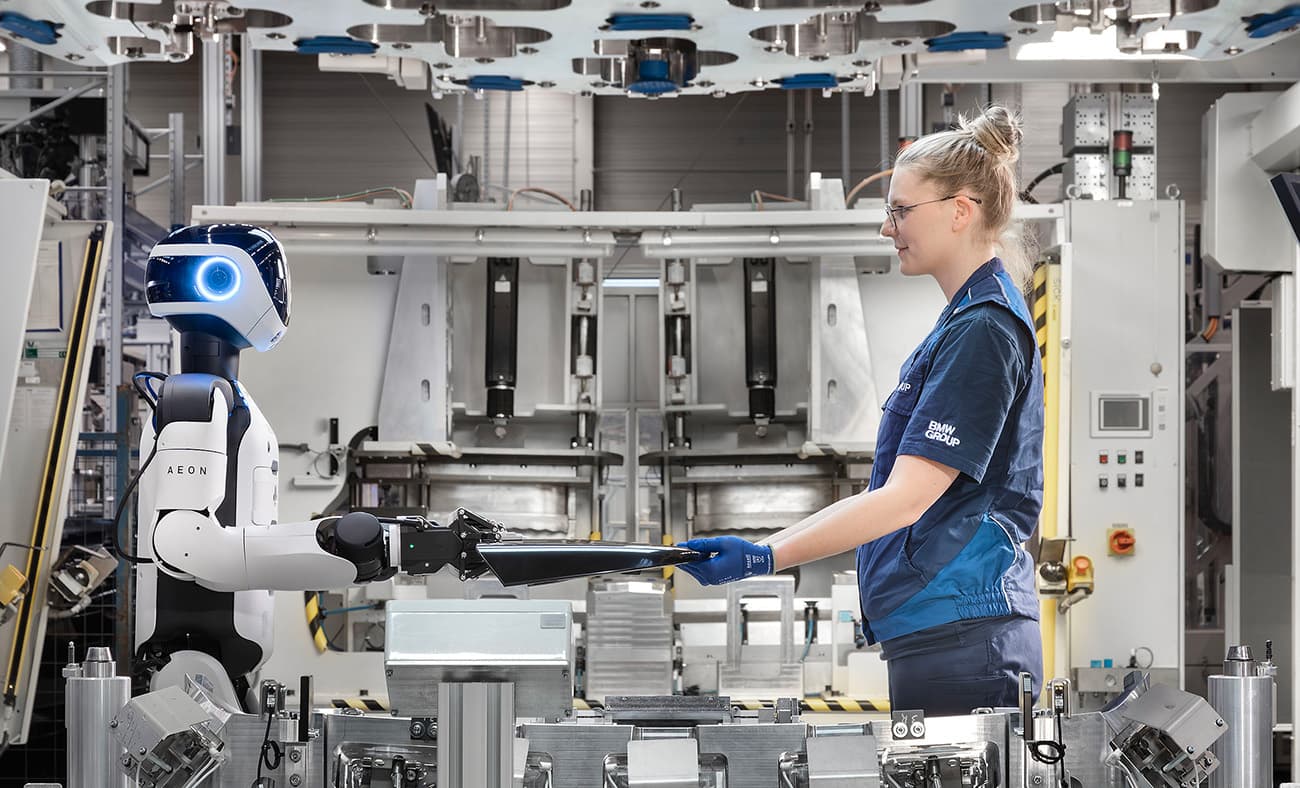
Hexagon's AEON, the third one, is the European headliner. 1.65 metres tall, 60 kilograms, wheels instead of feet, 22 sensors, self-swapping batteries that change in 23 seconds, top speed 2.5 m/s. Hexagon Robotics built it on NVIDIA's physical AI stack, and it is being deployed at the BMW Plant in Leipzig as the first humanoid in a German production line. The training story is the part to pay attention to: imitation learning lets AEON pick up a new task from twenty demonstrations.11 Test deployments started December 2025, expanded trials in April 2026, full pilot operation in summer 2026.
A panel discussion on Wednesday afternoon at the Center Stage covers the future of humanoid robotics with Microsoft, NVIDIA, Hexagon, Agile Robots, BMW, and Schaeffler on stage together.2 Two automakers, two robotics companies, two platform vendors. That cast list is the actual story.
Microsoft + Siemens: design-to-manufacture in one loop
The headline demo at the Microsoft booth is a continuous flow where AI designs a product and Siemens manufactures it. End-to-end, one interface, both sides of the wall. If it works the way the press materials say, it is the first credible answer to the question that has been hanging over Industrial Copilot since launch: what does this actually do for the production manager on Tuesday morning?
Industrial Copilot at the Microsoft booth: the test is whether a visitor can actually click through a full design-to-manufacture loop on the show floor. (Source: Siemens NX Manufacturing Blog)
The Vendor Stack Beyond the Big Three
The Microsoft / NVIDIA / Siemens triangle is the one in every press release, but the second tier of the show is doing the substance work. A few that matter:
ABB is integrating NVIDIA Omniverse libraries and Microsoft Azure cloud services into ABB Genix, its Industrial IoT and AI Suite. The pitch is that operations teams can engage AI agents to accelerate root-cause analysis on asset performance. Microsoft is calling ABB, Krones, and TK Elevator the "Frontier industrial organizations".6 Three named customers, on the slide. That is what the 2025 booth banners did not have.
SAP brought the most concrete announcement of the show in terms of shippable product. They are operationalising agentic AI inside the supply chain with seven named agents and GA dates: Production Master Data Agent and Production Planning and Operations Agent (GA Q2 2026), Field Service Dispatcher Agent (GA Q2 2026), Material Reservation Agent (GA Q2 2026), Outbound Task Orchestration Agent (GA Q2 2026), Alert Processing Agent (GA Q3 2026), Asset Health Agent (GA Q3 2026).12 If you want to know what an "agentic enterprise" actually looks like, this is it: named agents with quarter-specific GA dates inside the system of record half the world's manufacturers already run.
Lenovo is leaning hard on the production-scale claim: AI solutions deployed across its own global manufacturing operations, then productised for customers, with up to 85% faster lead times.13 The "we eat our own dog food" pitch from a vendor that actually ships PCs at scale is more credible than most.
SEW-EURODRIVE is showing a "Startup Agent": an AI-based chat function that lets engineers configure machines and robots through natural dialog instead of menu trees, cutting commissioning time. Hall 13, Booth C68. This is the kind of mid-market industrial-vendor product that tells you the agentic pattern has reached the German Mittelstand, not just the platform vendors.
Wandelbots is demonstrating its NOVA Platform combined with NVIDIA Omniverse NuRec for digitising real facilities into physically accurate simulations, with Gessmann's GESSbot robots as the customer reference. Robot programming, the part that has historically taken weeks per cell, is the bottleneck most factories actually feel. NOVA + NuRec is one of the genuinely interesting attacks on it.
Bosch Connected Industry is on the floor with intelligent maintenance and connected production demos. Less spectacular than the humanoid demos one hall over, but Bosch shipping a serious AI suite is a leading indicator for what arrives in mid-tier factories two years from now.
Sovereign AI: The European Stack
The story underneath all of the above is about whose data centre runs the agents, and the German answer is being built right now.
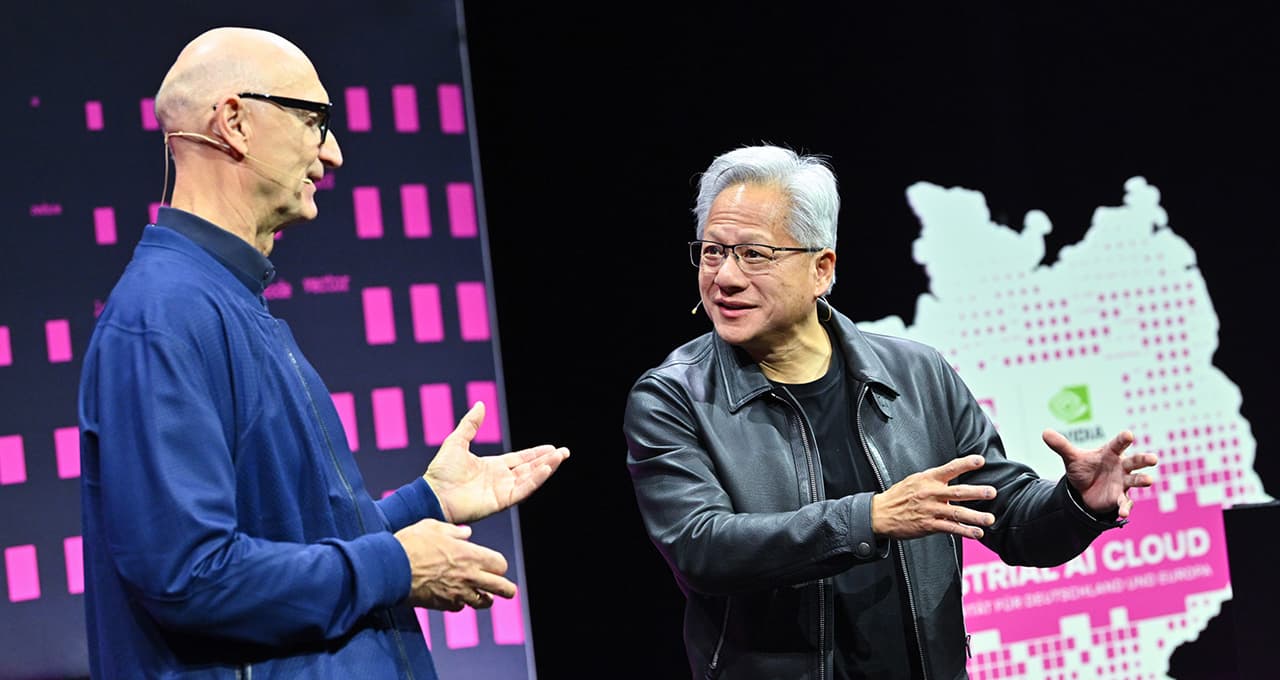
Deutsche Telekom and NVIDIA went live this year with the Industrial AI Cloud, called by both companies the world's first sovereign industrial AI factory. Built in a renovated Munich data centre. More than one thousand NVIDIA DGX B200 systems and RTX PRO Servers, with up to 10,000 Blackwell GPUs running CUDA-X, Omniverse, and AI Enterprise software. The construction will increase Germany's total AI compute capacity by approximately fifty percent in one stroke.14
Jensen Huang and Tim Höttges unveiling the Industrial AI Cloud. 10,000 Blackwell GPUs in Munich, +50% to Germany's total AI compute capacity, and a sovereignty story explicitly aimed at European manufacturers. (Source: NVIDIA Blog)
Federal Minister for Digital Transformation Karsten Wildberger and Federal Minister of Research Dorothee Bär framed the Industrial AI Cloud as the first tangible outcome of the "Made for Germany" initiative. Schwarz Digits, the IT arm of the retail group that owns Lidl and Kaufland, is the second sovereign infrastructure player in the conversation, focused on AI-supported secure data and cloud infrastructures for industry. The pattern across both: a deliberate decoupling from US hyperscaler dependency at the data layer, while still using US silicon and US frontier models on top.
This is the part of the show that is not about a single demo. It is about which legal jurisdiction owns the data centre that runs the agent that runs your line. For three years, "where is your data" was a compliance question. In 2026 it is a procurement question, with a German answer.
The honest caveat
Press cycles are part of the marketing. Everything above is what the vendors
and the trade press want the industry to think about Hannover Messe 2026. The
substance test is whether the demos behind the press releases hold up under a
few minutes of scrutiny on the floor.
The Wider Stage
A few other things are happening on the floor that change the read of the show:
The Defense Production Area is brand new this year, a forward-looking exhibition format with around forty companies focused on production technology for the European security and defence industry. Suppliers showing how the same advanced manufacturing techniques scale into security-critical production. This is not a small addition. It is Hannover Messe acknowledging that European industrial sovereignty has a defence dimension, and that the same vendors building the Industrial AI Cloud are going to be asked to work on systems with very different oversight requirements.
Brazil as partner country is more substantive than the usual diplomatic backdrop. Lula's biofuels challenge to German automakers and the ten signed industrial agreements are a real bilateral programme, not a stage prop.5 Germany shoring up an industrial supply-chain partner outside of the US-China axis fits the same sovereignty theme as the data centre story.
China's ~700 exhibitors and Xpeng's Hall 26 stand are the other half of that geopolitics. The German answer to industrial AI is a stack with American silicon, German operations, European jurisdiction, and Chinese hardware in the supply chain. Hannover Messe 2026 is the floor where you can actually see all four sit next to each other.
Why The Past Years Felt Like a Joke
In 2023 and 2024, "AI" at Hannover Messe was a sticker. Most of the AI claims on the show floor were either rebranded statistics features (anomaly detection that had been shipping since 2014, suddenly called "predictive AI"), demo videos of LLMs answering plant manager questions in a pre-recorded loop, or pure futureware: a startup with three engineers and a roadmap to "build the OS for autonomous factories".
The 2025 ARC Advisory writeup framed the previous year as "from hype to reality".15 That was generous. It was a lot of pavilion theatre and very few customer logos that had not been blurred. The pattern was: vendor demo on the booth screen, customer name in the press release, no live system you could click through.
What changed for 2026:
Named customers, on the slide. PepsiCo with Siemens Omniverse. ABB, Krones, TK Elevator with Microsoft as "Frontier industrial organisations". BMW Plant Leipzig with Hexagon's AEON. Siemens Erlangen with Humanoid's HMND 01. Gessmann with Wandelbots. These are not "leading manufacturer in the food sector". These are logos with quotes attached.
Shippable product, with GA dates. SAP's seven named agents have Q2 and Q3 2026 ship dates. That is what an industrial AI roadmap looks like when it is real, not when it is a slide.
The vendor stack rationalised. Microsoft + Siemens + NVIDIA show up as one stack across multiple booths instead of three competing pitches. ABB and Hexagon are both on it. Wandelbots is on it. That is a strong signal that the integrations are real enough to demo together.
Robots that are not on rails. Three humanoids deployed in three different German factories in 2026: AEON at BMW Leipzig, HMND 01 at Siemens Erlangen, Agile ONE in industrial pilot. These are concrete deployment stories, not controlled demo loops.
Sovereign infrastructure. The Industrial AI Cloud is online, in Munich, with 10,000 Blackwell GPUs. Germany has somewhere to point when a customer asks "but where will the agents actually run".
The political weight. The Chancellor blocking time on day one for industrial AI is not a thing that happens during a hype cycle. It happens when a sector is becoming a national-policy variable.
Roland Berger's framing for the show is "the next phase of industrial intelligence", with the fusion of advanced automation, AI, and digital integration as the throughline.16 That is consultancy-speak, but it captures the shift well: the question stopped being "is AI useful in manufacturing" and started being "which AI integrations have shipped".
What Separates Substance From Theatre
Four things distinguish a real industrial AI play from a press-release-shaped object:
One end-to-end agent loop, live. Not a video. Not a slide. A real workflow where an agent does the next step, in real time, in front of someone. If the only working agent demo is a chatbot answering FAQs, the "agentic" framing is still ahead of the product.
Humanoids actually doing tasks. Picking parts and walking them somewhere, not the same canned arm wave on a loop while a video plays in the background.
An integration timeline, not just an "AI-ready" sticker. A vendor that can name the integration partners, the deployment timeline, and the data plumbing has shipped something. A vendor that calls their PLC "AI-ready" has not.
"Governed" / "trustworthy" / "explainable" as real APIs. If the agentic platform has a permissions model, an audit log, and a rollback story, it is real. If those words only show up on the keynote slide, it is not.
By those four tests, 2026 is the first edition where the AI story has more candidates that pass than fail. That is the shift. Not "AI is here", which has been on every booth banner since 2023, but "AI is producing things that have a customer name and a deployment date attached".