2026
February 20, 2026
Nobody Said That, LinkedIn
LinkedIn is flooded with posts debunking positions nobody holds. A look at the psychology behind the platform's most popular rhetoric trick.

Software developer
7 min read
February 20, 2026
LinkedIn is flooded with posts debunking positions nobody holds. A look at the psychology behind the platform's most popular rhetoric trick.
Software developer
7 min read
Last week I scrolled through my LinkedIn feed and stopped counting after 10 minutes.
Seven posts. All following the same pattern:
This isn't discourse. It's performance.
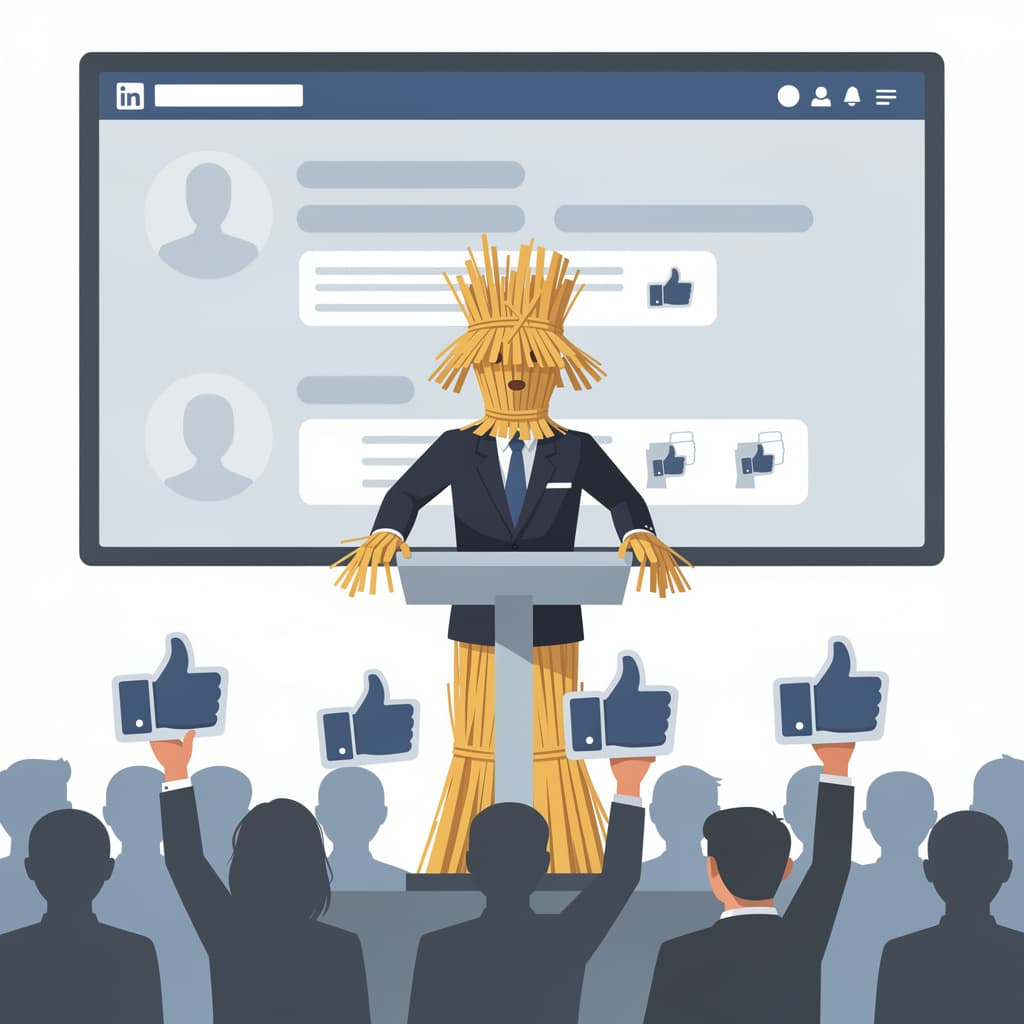
A strawman argument works like this: You take your opponent's position, distort it beyond recognition, and then refute the distorted version. You win a debate that never took place.
In philosophy, this is a classic logical fallacy. On LinkedIn, it's a content strategy.
A post begins like this:
"Everyone's saying AI will completely replace developers. But that's not quite right."
Sounds reasonable. Except: Who's saying that? Which serious person genuinely claims that all developers will be unemployed tomorrow? Sure, there are clickbait headlines in tech media. But the community largely agrees that AI is a tool, not a replacement.
So the author sets up an extreme position that hardly anyone holds in this form, then elegantly refutes it. The result: hundreds of likes, comments like "Finally someone says it!" and the algorithm celebrates.
LinkedIn strawman posts activate several psychological mechanisms at once:
People preferentially engage with content that confirms their existing beliefs. When a post refutes a position you already disagree with, it feels like validation. You like, comment, share. Not because you learned something new, but because someone said loudly what you already think.
The strawman creates an invisible "Us vs. Them." The enlightened thinkers vs. the naive hype followers. The experienced devs vs. the "vibe coders." Every like is a tribal signal: "I belong to the smart ones."
Posts that reduce complex topics to a simple "Most people don't get it, but I do" appeal to a sense of superiority. The reader thinks: "Yes, exactly. I get it too. We're the exception." In reality, a nuanced debate has been reduced to a yes-or-no.
LinkedIn's algorithm rewards engagement. Controversial (or pseudo-controversial) posts generate more reactions. More reactions mean more reach. The platform itself actively selects for this kind of content.
Over the months, I've observed three main variants:
"90% of [profession] will fail. 🚨 Not because of [obvious reason]. Because of [dramatic pause]... [banal insight]. 💡"
The author positions themselves as a lone voice in the wilderness, speaking an uncomfortable truth. In reality, the "truth" is so general that hardly anyone would disagree. But through dramatic framing, it feels like they just opened the Ark of the Covenant.
"I do [seemingly controversial thing]. And I'm more productive than ever. 🤷"
The confession implies that the mainstream believes the opposite. "I barely write code anymore" suggests that the norm is every developer typing for 8 hours straight. Which is nonsense, obviously. But it creates the feeling of a brave deviation.
"Will [profession] even find jobs in X years?! 😱"
Here an existential question is raised that positions the author as a concerned thought leader. The answer is always: "It depends." But that's not the point, of course. The point is the engagement that the fear generates.
"It's harmless," you might think. "It's just LinkedIn." But:
It poisons the discourse. When every other discussion is based on a distorted premise, genuine debate becomes impossible. You're no longer discussing reality, but caricatures of reality.
It hurts newcomers. Junior developers reading LinkedIn get a completely distorted picture of the industry. They believe that "90% fail," that they're lost without an AI workflow, that nobody writes "real" code anymore. This creates unnecessary pressure and misplaced priorities.
It devalues expertise. When the most successful content isn't the most nuanced but the loudest, real experts lose visibility. The marketplace of ideas becomes a marketplace of performances.
It's intellectually lazy. Refuting a strawman requires no expertise. It only requires the willingness to construct a weak position and then confidently tear it apart. Anyone can do that. That's exactly why so many do.
Before you like the next LinkedIn post, ask yourself:
And if you write content yourself: Steelman the opposing position. Take the strongest version of the argument you want to refute. It's harder. It generates fewer likes. But it's honest.
Let's take the "AI replaces developers" topic. Here's what the strawman version looks like:
Strawman: "Everyone says AI will replace all developers. But that's nonsense. You still need humans who understand code."
Nobody credible says "all developers, gone, tomorrow." The author refutes a phantom and looks wise doing it.
Now the steelman version:
Steelman: "There's a reasonable argument that AI will reduce the number of entry-level developer positions. Companies are already using AI tools to handle tasks that used to be delegated to juniors: boilerplate code, simple bug fixes, test writing. If that trend continues, the traditional career ladder (junior to mid to senior) could break. The counterargument is that AI creates new categories of work and that juniors who learn to work with AI become more valuable, not less. Both sides have merit, and the honest answer is: we don't know yet."
Same topic. But instead of knocking down a caricature, the steelman version engages with the strongest form of the argument. It doesn't pretend to have all the answers. It treats the reader as someone capable of holding two ideas at once.
The difference is simple: A strawman makes the author look smart. A steelman makes the reader smarter.
If you've read this far and been nodding along, I have uncomfortable news.
This article is itself a strawman argument.
I've portrayed "LinkedIn content creators" as a monolithic group all following the same playbook. I took the weakest examples and acted as if they were representative. I constructed a position ("All LinkedIn posts are shallow strawman arguments") and then refuted it by positioning myself as the enlightened observer.
I did exactly what I'm criticizing.
The truth is: Yes, there is bad content on LinkedIn. There's also great content. There are posts that genuinely provoke thought, that argue with nuance, that share real expertise. But you don't write viral blog articles about those. Because nuanced truth is less clickable than outraged oversimplification.
That's the actual point. Not "LinkedIn is bad." But: We're all susceptible to the same mechanisms. You, me, the LinkedIn thought leader with 50,000 followers. Confirmation bias doesn't discriminate by follower count.
So the next time you see an outraged post in your feed and think "Finally someone says it!", pause for a moment. Maybe you just liked a strawman.
Or maybe you just liked a blog article about one.
Research on how strawman arguments function as a tool for social status signaling.
Yeomans (2022) on how people systematically misrepresent opposing views, even unintentionally.
PNAS study showing that content targeting an out-group generates disproportionately more engagement.
Research on the reinforcing loop between confirmation bias and echo chambers on social media.
Empirical study on why strawman arguments are effective at persuading audiences.
Scientific American on how cognitive biases interact with social media algorithms.